

By-Law to Redevide Ward Boundaries
Being a by-law to redefine the ward boundaries for the City of Clarence-Rockland.
WHEREAS Section 222(1) of the Municipal Act, 2001 S.O. 2001, c. 25, as amended, provides that a municipality is authorized to divide or re-divide the municipality into wards or to dissolve the existing wards;
AND WHEREAS a comprehensive and independent ward boundary review has been completed by Watson & Associates Economists Ltd.;
AND WHEREAS public engagement was delivered both virtually and in person throughout the process to seek public input;
AND WHEREAS Council received the Ward Boundary Review Preliminary Report on April 9, 2025 and the Ward Boundary Review Final Report on June 11, 2025;
NOW THEREFORE, the Council of The City of Clarence-Rockland hereby enacts as follows:
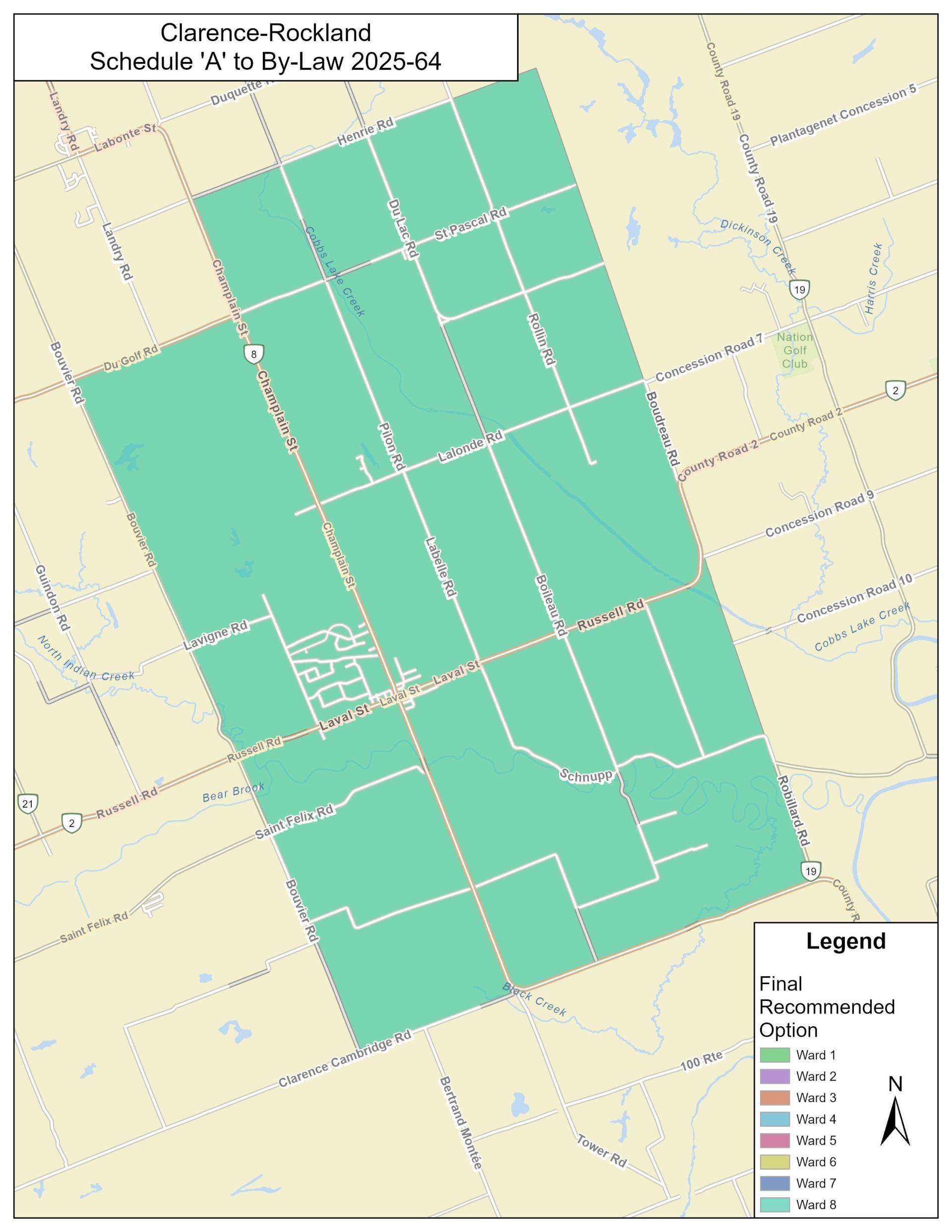
- THAT the number of wards in the City of Clarence-Rockland is set at eight (8) and shall be divided as described in Schedule ‘A’, which is attached and forms part of this by-law.
- THAT the Clerk is hereby authorized and directed to complete all requirements necessary to give effect to this By-law, including giving notice.
- THAT pursuant to Section 222(8) of the Municipal Act, the new ward boundaries shall come into force and effect on the day the new Council of the Corporation of the City of Clarence-Rockland is organized following
the 2026 Municipal Election. - THAT pursuant to Section 222(9) of the Municipal Act, the 2026 Municipal Election shall be conducted as if this by-law was already in force.
Read, passed and adopted in open council this 11th day of June, 2025.
Mario Zanth, Mayor
Monique Ouellet, Clerk
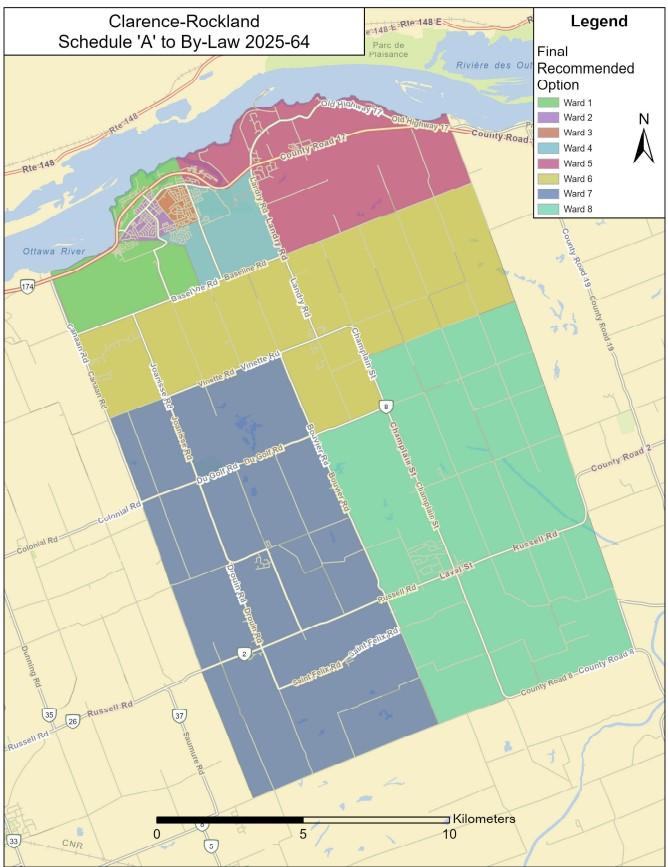
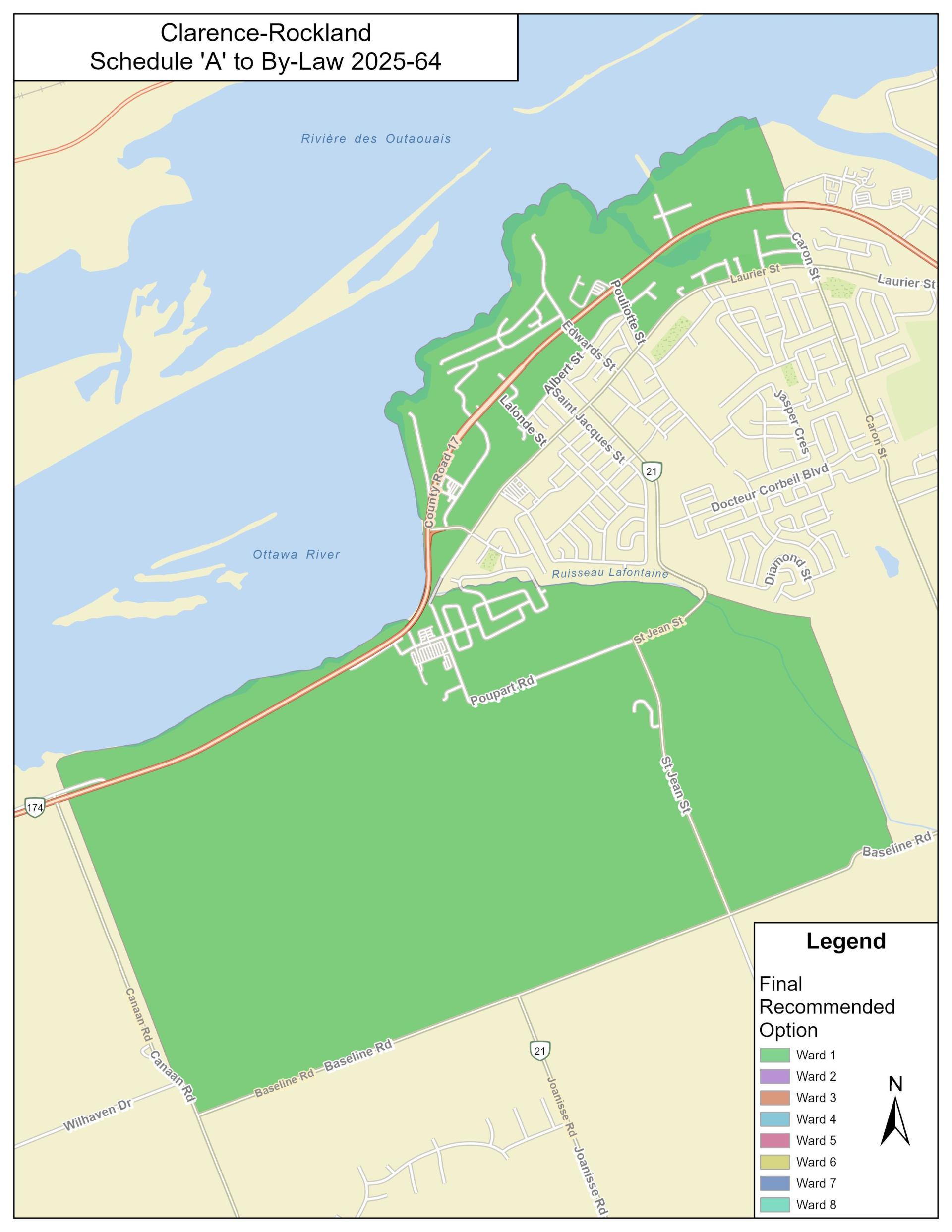
Beginning at the point where the municipal boundary of the City of Clarence-Rockland meets the municipal boundary of the City of Ottawa on the shoreline of the Ottawa River, then in an easterly direction along the shoreline of the Ottawa River to a line extended to the shoreline from the centre line of Caron Street, then in a southerly direction to the centre line of Caron Street. Continuing along the centre line of Caron Street to the centre line of Laurier Street, then in a westerly direction along the centre line of Laurier Street west to Pouliotte Street then in northern direction to Albert Street. In a westerly direction along the centre line of Albert Street to Lalonde Street, then in a westerly direction along the centre line of Laurier Street to Lafontaine Creek, then in an easterly and southerly direction along Lafontaine Creek to the northeast corner of parcel #402000, then south along the eastern boundary of parcel #402000 to the centre line of Baseline Road, then in a westerly direction along the centre line of Baseline Road to municipal boundary of the City of Clarence-Rockland with the City of Ottawa (Canaan Road), then in a northerly direction along the municipal boundary of the City of Clarence-Rockland with the City of Ottawa to the point of beginning.
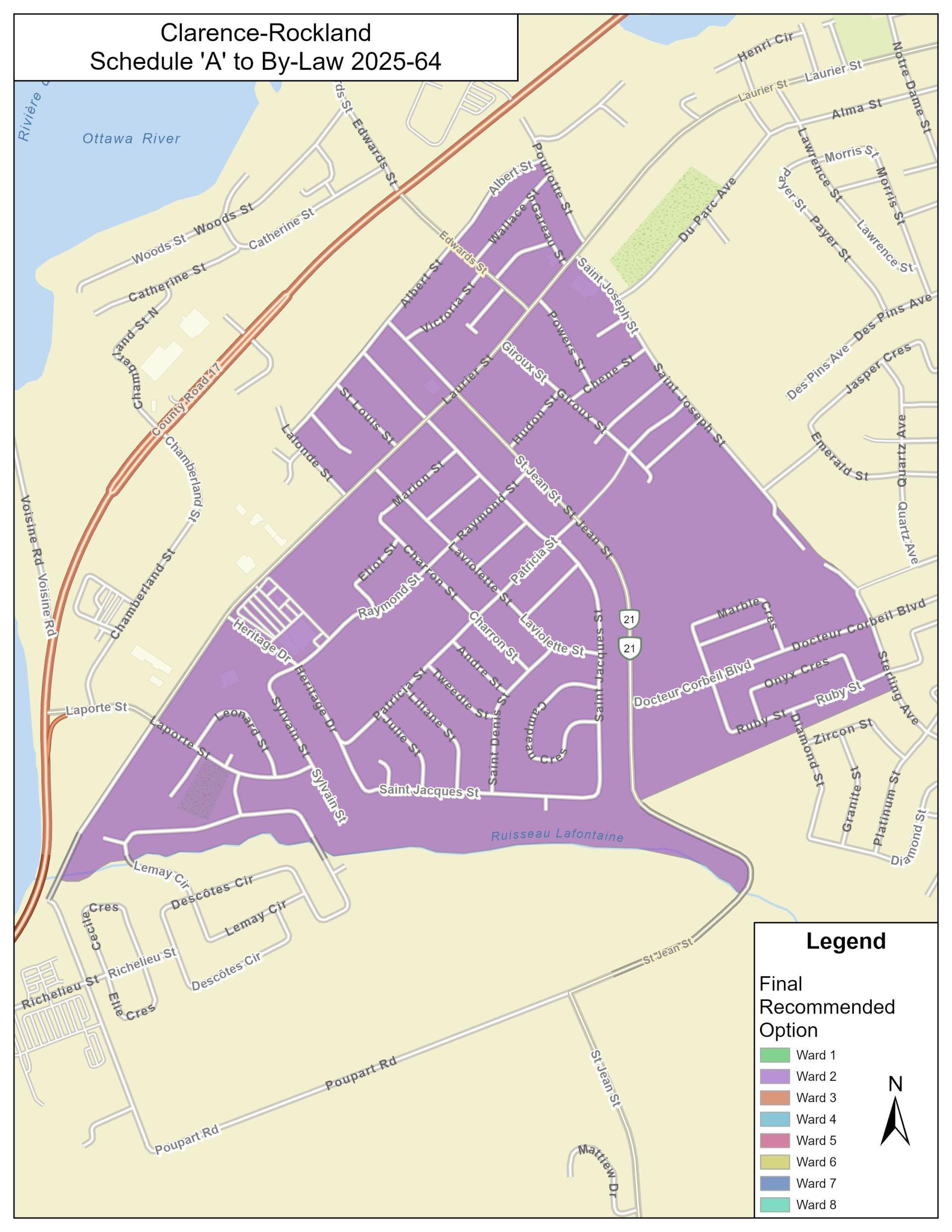
Beginning at the point where the centre line of Laurier Street intersects with Lafontaine Creek then in an easterly direction along the centre line of Laurier Street to Lalonde Street, then in a northern direction along Lalonde Street’s centre line to Albert Street, in an easterly direction of Albert Street’s centre line to Pouliotte Street, then in a southernly direction along the centre line of Pouliotte Street to Laurier Street then in an easterly direction along the centre line of Laurier Street to the centre line of St. Joseph Street, then in a southerly direction along the centre line of St. Joseph Street/Sterling Avenue to a walking path that splits neighbourhoods to the east of Lafontaine Creek, then in a westerly direction along the walking path that splits the neighbourhoods to the east of Lafontaine Creek to the centre line of St. Jean Street, then in a southerly direction along the centre line of St. Jean Street to Lafontaine Creek then in a northerly and westerly direction along Lafontaine Creek to the point of beginning.
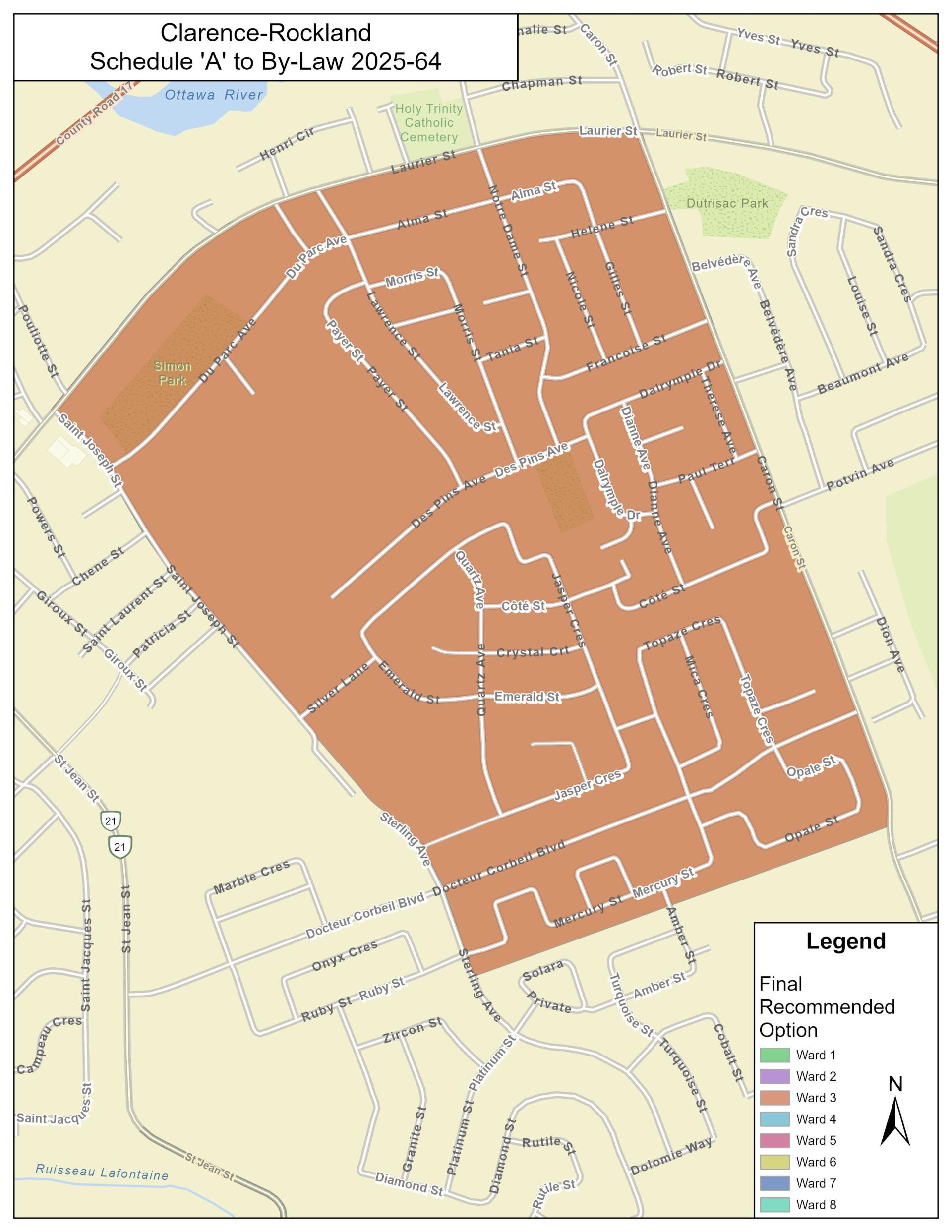
Beginning at the point where the centre line of Laurier Street intersects with the centre line of St. Joseph Street, then in an easterly direction centre line of Laurier Street to the centre line of Caron Street, then in a southerly direction along the centre line of Caron Street a walking path that splits neighbourhoods to the east of Lafontaine Creek, then in a westerly direction along the walking path that splits neighbourhoods to the east of Lafontaine Creek to the centre line of Sterling Avenue, then in a northerly direction along the centre line of St. Joseph Street to the point of beginning.
Beginning at the point where the centre line of Laurier Street intersects with the centre line of Caron Street, then in an easterly direction along the centre line of Laurier Street and County Road 17 to the centre line of Landry Road, then in a southerly direction along the centre line of Landry Road to the centre line of Baseline Road, then in a westerly direction along the centre line of Baseline Road to a point between land parcels located between St. Jean Street and Caron Street, then in a northerly and westerly direction to Lafontaine Creek then in a northerly and westerly direction along Lafontaine Creek to the centre line of St. Jean Street, then in a northerly direction along the centre line of St. Jean Street a walking path that splits neighbourhoods to the east of Lafontaine Creek, then in an easterly direction along the centre line of the walking path that splits neighbourhoods to the east of Lafontaine Creek to the centre line of St. Joseph Street, then in a northerly direction along the centre line of St. Joseph Street to the point of beginning.
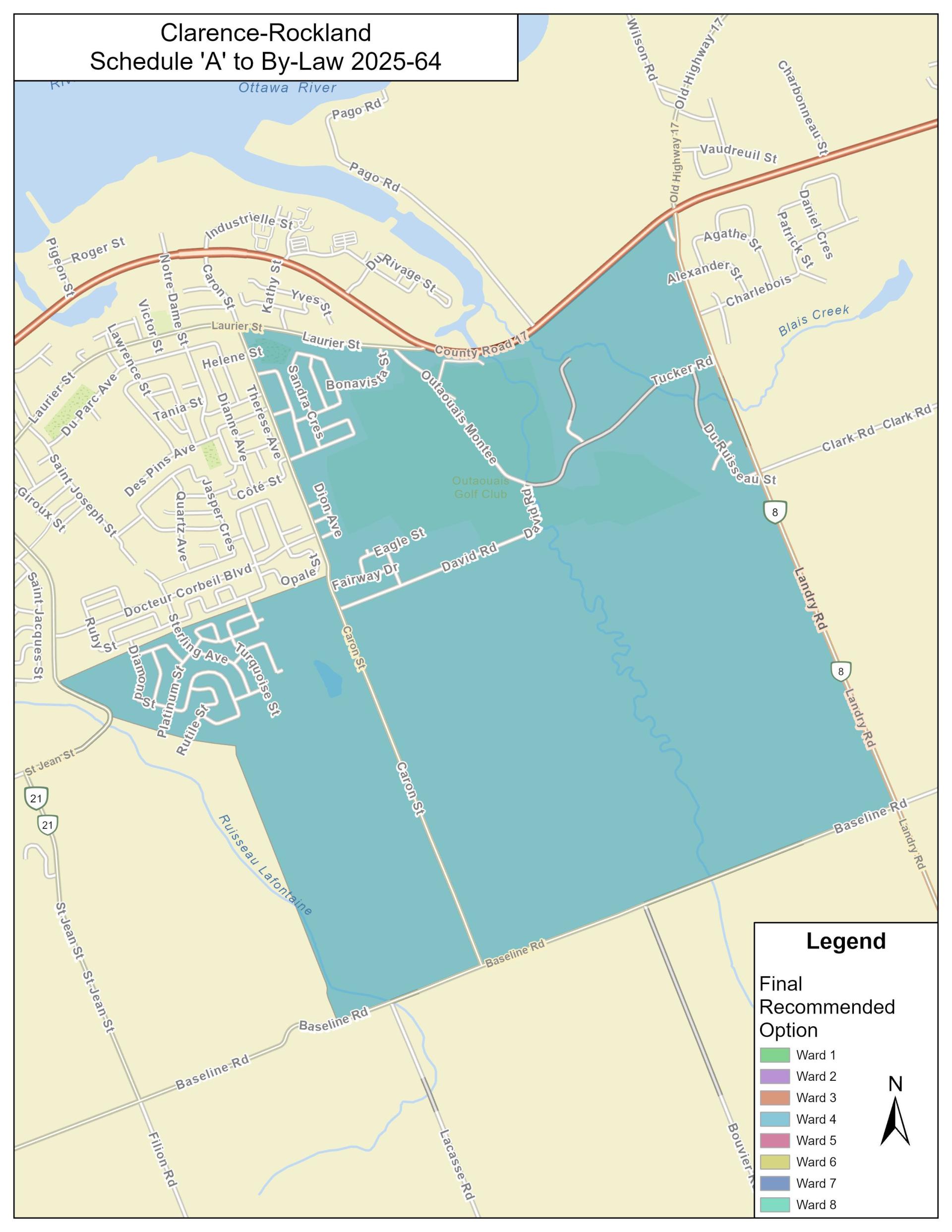
Beginning at the point where a line extended from the centre line of Caron Street meets the shoreline of the Ottawa River, then in an easterly direction along the shoreline of the Ottawa River to the municipal boundary of the City of Clarence-Rockland with the Township of Alfred and Plantagenet (Division Street), then in a southerly direction along the municipal boundary of the City of Clarence-Rockland and the Township of Alfred and Plantagenet (Division Street) to the centre line of Baseline Road, then in a westerly direction along the centre line of Baseline Road to the centre line of Landry Road, then in a northerly direction along the centre line of Landry Road to the centre line of County Road 17, then in a westerly direction along the centre line of County Road 17 to the centre line of Laurier Street, then in an easterly direction along the centre line of Laurier Street to the centre line of Caron Street, then in a northerly direction along the centre line of Caron Street and a line extended from the centre line of Caron Street towards the Ottawa River to the point of beginning.
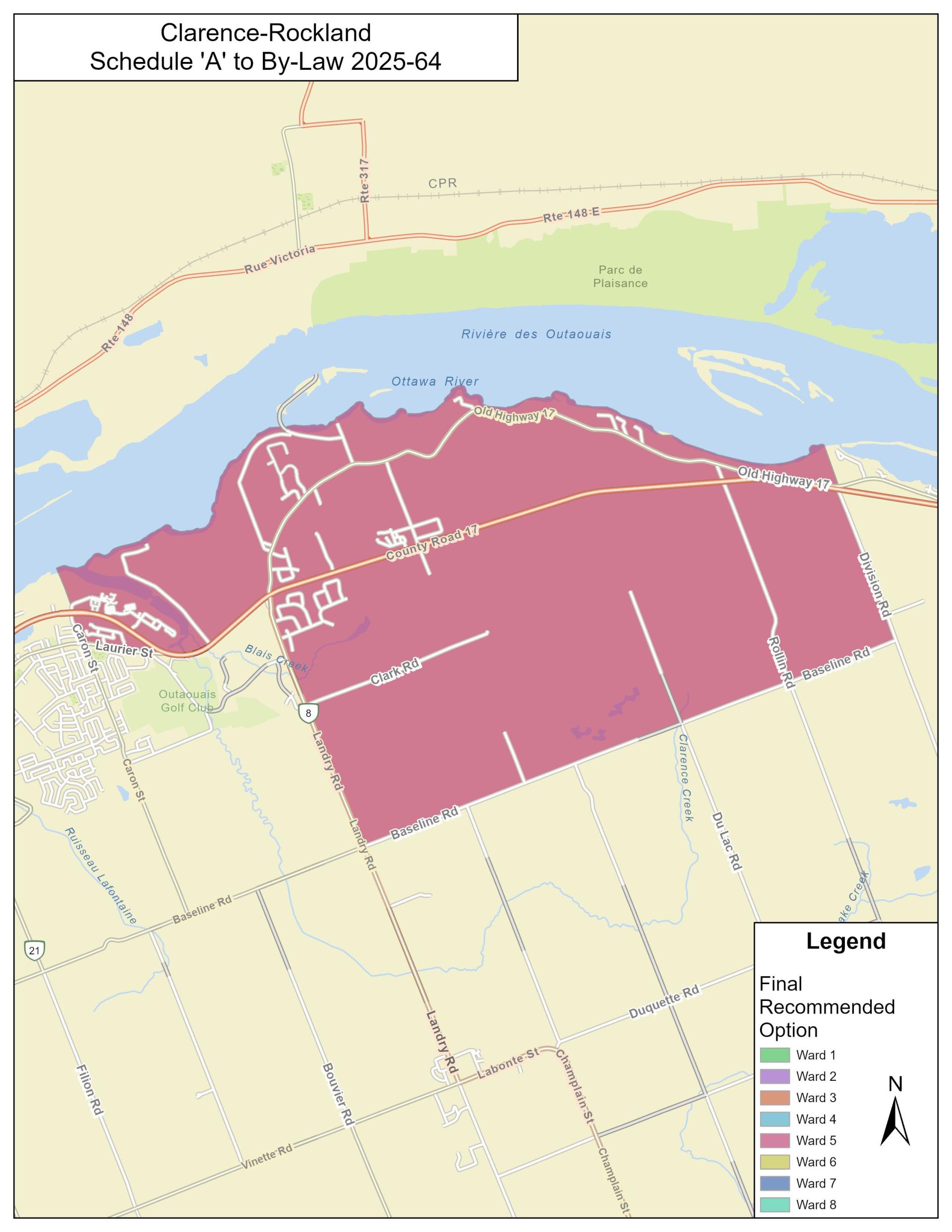
Beginning at the point where the centre line of Baseline Road intersects with the municipal boundary between the City of Clarence-Rockland with the City of Ottawa (the centre line of Canaan Road), then in a easterly direction along the centre line of Baseline Road to the municipal boundary between the City of Clarence-Rockland and the Township of Alfred and Plantagenet (Division Street), then in a southerly direction along the centre line of Division Street to a line extended from the centre line of Henrie Road, then in a westerly direction along the centre line of Henrie Road to the centre line of Champlain Street, then southerly along the centre line of Champlain Street to the centre line of du Golf Road, then westerly along the centre line of du Golf Road to the centre line of Bouvier Road, then northerly along the centre line of Bouvier Road to the centre line of Vinette Road, then westerly along the centre line of Vinette Road to the municipal boundary between the City of Clarence-Rockland with the City of Ottawa (the centre line of Canaan Road), then northerly to the point of beginning.
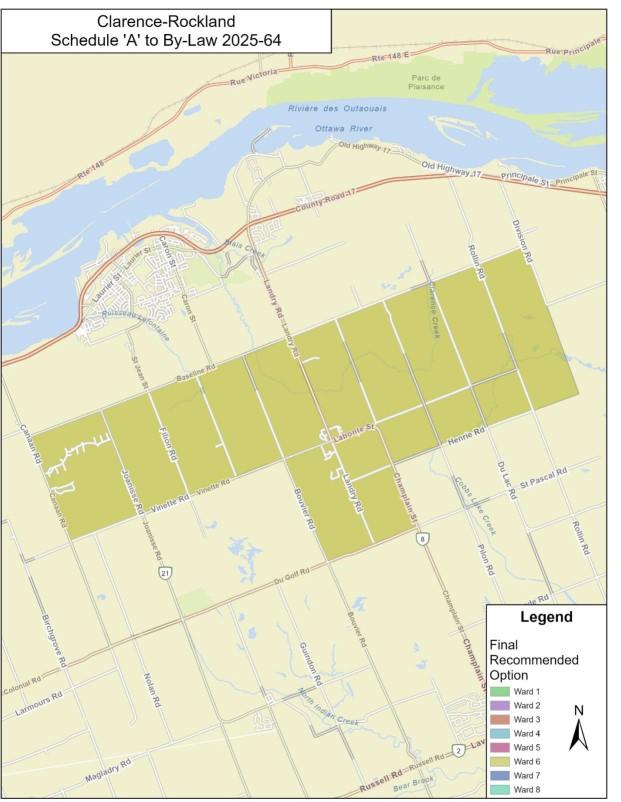
Beginning at the point where the centre line of Vinette Road intersects with the municipal boundary between the City of Clarence-Rockland with the City of Ottawa (the centre line of Canaan Road), then in an easterly direction along the centre line of Vinette Road to the centre line of Bouvier Road, then in a southerly direction along the centre line of Bouvier Road to the municipal boundary between the City of Clarence-Rockland and the Municipality of The Nation (the centre line of Indian Creek Road), then in a westerly direction along the municipal boundary between the City of Clarence-Rockland and the Municipality of The Nation), then in a northerly direction along the municipal boundary between the City of Clarence-Rockland with the City of Ottawa) to the point of beginning.
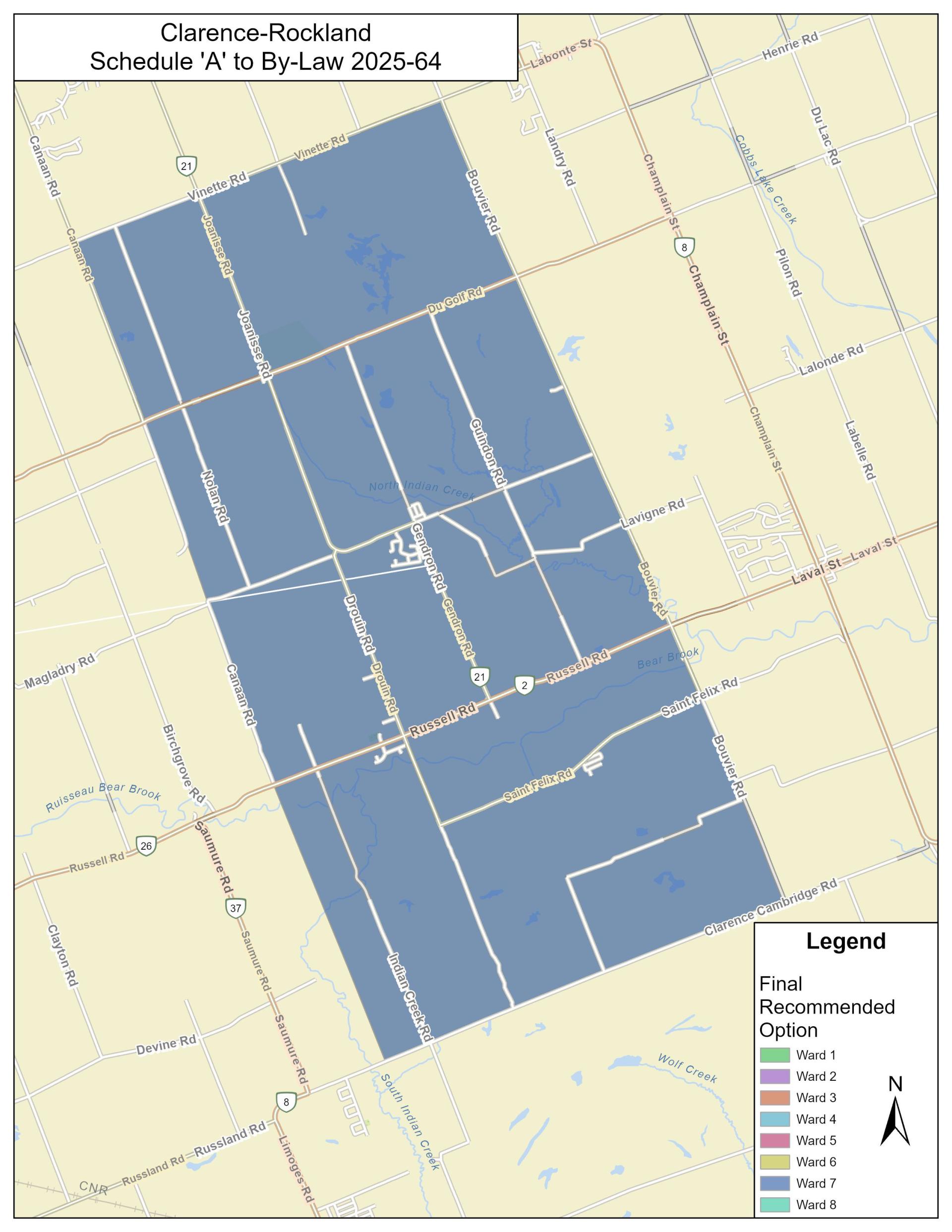
Beginning at the point where the centre line of du Golf Road intersects with the centre line of Bouvier Road, easterly to the centre line of Champlain Street, then in a northerly direction along the centre line of Champlain Street to centre line of Henrie Road, then in an easterly direction along centre line of Henrie Road and a line extended from Henrie Road to the municipal boundary between the City of Clarence-Rockland and the Township of Alfred and Plantagenet)then in a southerly direction along the municipal boundary between the City of Clarence-Rockland and the Municipality of The Nation (Boudreau Road, Robillard Road) to the centre line of County Road 8, then in a westerly direction along the centre line of County Road 8 and Indian Creek Road to the centre line of Bouvier Road, then in a northerly direction along the centre line of Bouvier Road to the point of beginning.
The Clarence-Rockland Ward Boundary Review
Setting
The City of Clarence-Rockland was formed on January 1, 1998, following a Ministerial Order from March 27, 1997. This order combined the former Town of Rockland and the Township of Clarence into one new municipality called the City of Clarence-Rockland. The Police Village of Bourget was also dissolved as part of this change.
The City is one of eight lower-tier municipalities in the United Counties of Prescott and Russell. The Ministerial Order stated that the new City Council would have nine members: one Mayor and eight councillors. The Mayor is elected by all residents, while the eight councillors are elected from eight different wards, with one councillor per ward. The ward boundaries were set in 1997 and have not been changed since.

Have your say in shaping the future of your community! Participate in the public consultation on ward boundary reviews and help us ensure fair and effective representation for all.
April 29, 2025
4:00 pm - 5:30 pm
Conference room - Bourget Fire Hall
2130 Laval Street, Bourget
6:30 - 8:00
Conference room - Rockland Fire Hall
1550 Laval Street, Rockland
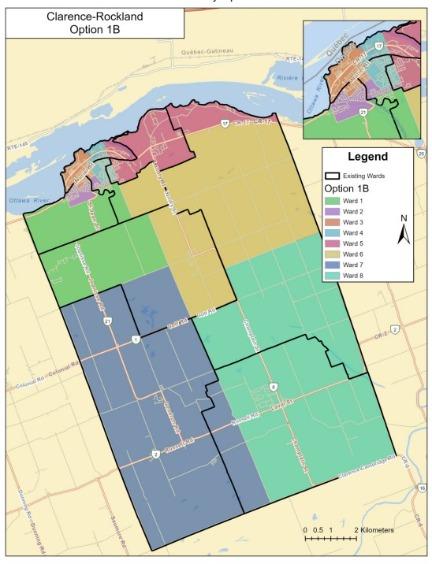
Existing Wards and Interactive Map
(click on the map to see existing ward configuration for Clarence-Rockland as well as the preliminary alternative ward options)
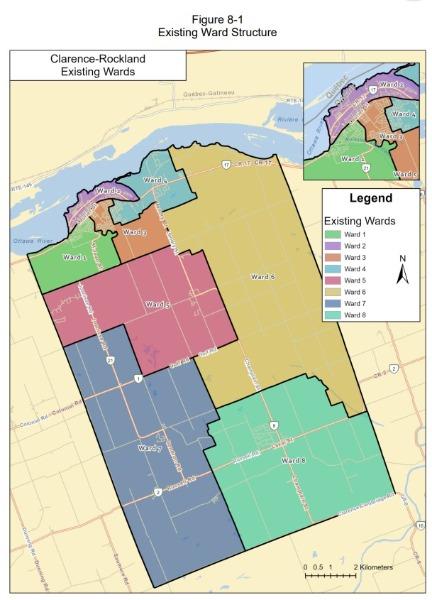
Option 1A
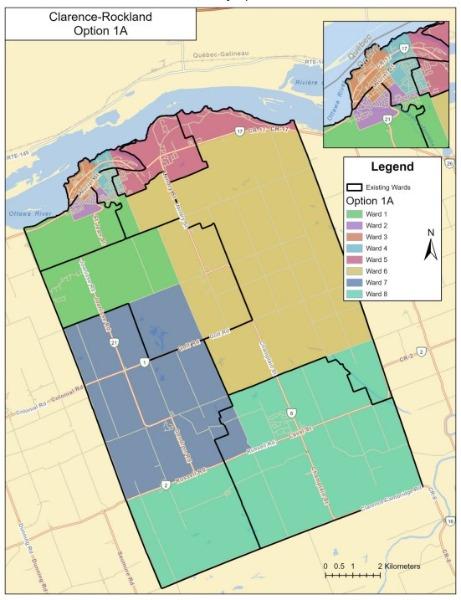
Option 1B
Option 2
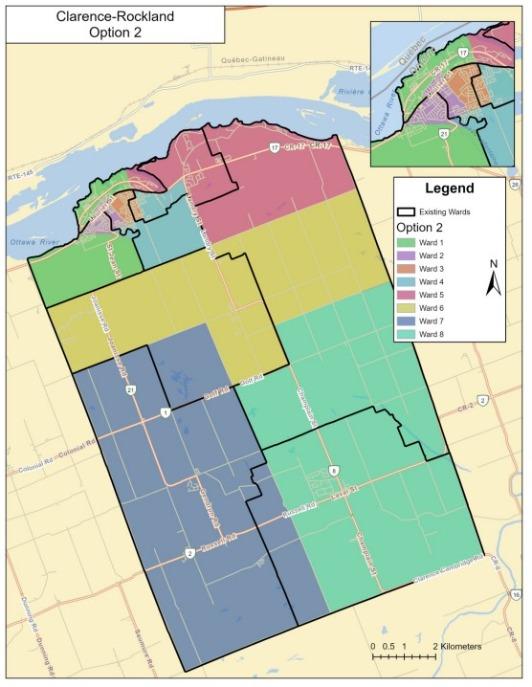
Option 3
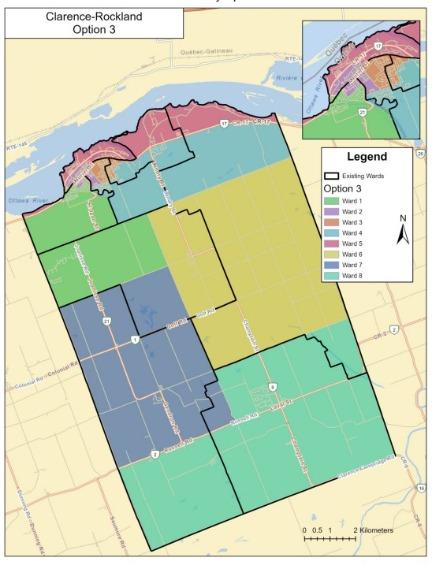
Option 4
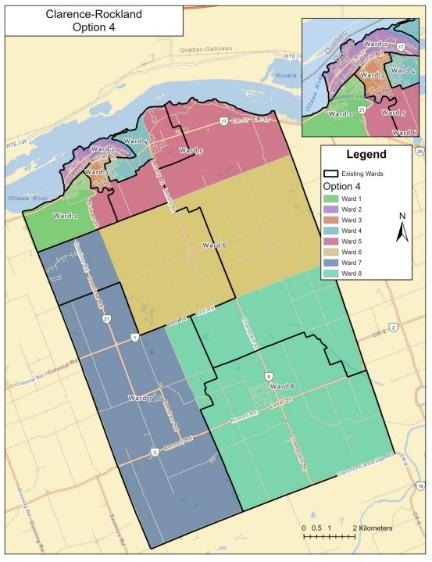
Option 5
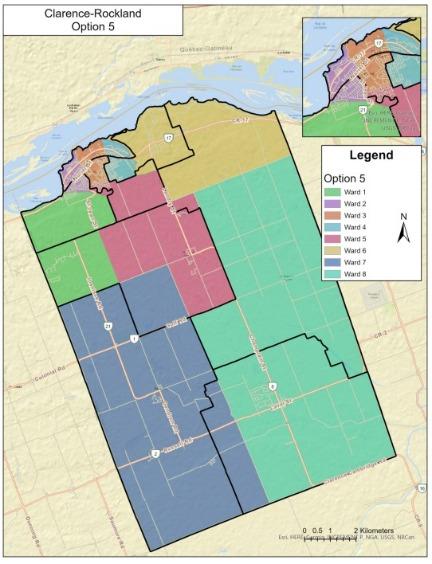
In Ontario, there are no clear rules or formulas for deciding how many councillors a city should have. Each city has its own history and traditions, and there's no set time to review the number of councillors.
The Municipal Act, 2001 only says that a city council must have at least five members, including one Mayor who is elected by everyone. There are no references to a maximum or to an “appropriate” size associated with, for example, the population of the municipality.
This absence contrasts with the provisions of regulations issued under the Education Act (Ontario Regulation 412/00) which include a detailed formula to determine both the number of trustees and their distribution across each school board’s area of jurisdiction before each regular municipal election.
As a result, the composition of local councils in Ontario varies widely. Clarence-Rockland's council has nine members, which is four more than the minimum. When compared to other cities in Ontario, Clarence-Rockland's council is the same size or larger than some bigger cities like Vaughan, Waterloo, Kawartha Lakes, and Belleville.
However, it's smaller than some rural or smaller cities like North Perth and Muskoka Lakes. Table Bi compares Clarence-Rockland’s council composition to the other municipalities in Prescott and Russell and Figure Bii compares Clarence Rockland’s council composition to selected municipalities in Ontario in the same population range.
Figure Bi - Population and Council Members United Counties of Prescott and Russell
| Municipality | 2021 CensusPopulation | Area(sq. km) | CouncilComposition | Election Format | Avg population per councillor |
|---|---|---|---|---|---|
| Township of Alfred and Plantagenet | 9,949 | 391.8 | 5 | 2 wards | 1,990 |
| Municipality of Casselman | 3,960 | 5.128 | 5 | At large | 792 |
| Champlain Township | 8,665 | 207.0 | 9 | 4 wards | 963 |
| City of Clarence-Rockland | 26,505 | 297.5 | 9 | 8 wards | 2,945 |
| Township of East Hawkesbury | 3.418 | 235.1 | 5* | At large | 684 |
| Town of Hawkesbury | 10,194 | 10.10 | 7 | At large | 1,456 |
| The Nation Municipality | 19,598 | 658.9 | 7 | 6 wards | 2,800 |
| Township of Russell | 13,350 | 198.8 | 5 | At large | 2,670 |
| Total / Average | 11,955 | 2,004 | 7 | - | 2,670 |
Source: Statistics Canada.
*Includes each Head of Council and the Deputy Mayor in East Hawkesbury.
Figure Bii - Population and Council Members, Selected Ontario Area Municipalities(Population 20,000 to 30,000)
| Municipality | 2021 CensusPopulation | Area(sq kms) | Council Composition* | Election Format | Avg population per councillor |
|---|---|---|---|---|---|
| Township of Essa | 22,970 | 279.9 | 5* | 3 wards | 4,594 |
| Town of Tecumseh | 23,300 | 94.59 | 7* | 5 wards | 3,329 |
| Municipality of Strathroy – Caradoc | 23,871 | 270.9 | 9* | 2 asymmetrical wards | 2,652 |
| Prince Edward County | 25,704 | 1,053 | 14 | 9 asymmetrical wards | 1,836 |
| City of Clarence-Rockland | 26,505 | 297.5 | 9 | 8 wards | 2,945 |
| Town of Wasaga Beach | 24,862 | 57.42 | 7* | At large | 3,552 |
| Town of Collingwood | 24,811 | 33.15 | 9* | At large | 2,757 |
| Town of Lincoln | 25,719 | 162.7 | 9 | 4 wards | 2,858 |
| King Township | 27,333 | 332.1 | 7 | 6 wards | 3,905 |
| Total / Average | 25,008 | 530.1 | 10 | - | 3,159 |
Source: Statistics Canada.
*Includes each Head of Council and the Deputy Mayor in Essa, Tecumseh, Strathroy-Caradoc, Wasaga Beach and Collingwood.
Legislative Authority
The Municipal Act, 2001 gives the City Council the power to decide how many councillors there should be (Section 217). This is separate from how they are elected (Section 222).
A key question for Clarence-Rockland is whether a nine-member council is the right size to govern a city of about 26,000 people, with more growth expected in the next decade.
Factors To Consider
The best size for a council depends on what it needs to do and how well it can do it.
Here are three important factors:
1. Effective Political Management
- Councillors need to handle important city tasks, but the amount of work can vary a lot.
- Serving on council is not a regular 9-to-5 job. Councillors need to review a lot of documents, handle resident issues, and participate in various committees and agencies.
- The size of the council affects how much time each councillor can spend on these tasks and on their personal lives.
2. Responsiveness
- Councillors should be able to stay in touch with the people they represent.
- A larger council can make it easier for residents to contact councillors and for councillors to gather information from different parts of the city.
- A smaller council can make it harder to maintain these connections, even though councillors are supposed to serve the whole city.
3. Accountability
- Councillors are responsible for their decisions and are held accountable by voters.
- A democratic system should give voters enough choices to select their representatives.
- The number of councillors affects how close the council feels to the community.
Conclusion
To decide the best size for Clarence-Rockland's council, we need to think about how well it can manage the city, how responsive it can be to residents, and how accountable it is to the public. These factors will help us understand if nine councillors are the right number or if a different size might work better.

Nine people serve on Clarence-Rockland Council: a mayor (“head of council”) and eight Councillors. The office of mayor and the way that person is elected are not open to modification in this review since under Provincial legislation there must be a “head of council” elected by general vote. * However, the remainder of the Council can be reconstituted should the community and Council see value in changing the status quo.
The Mayor: The Municipal Act, 2001 no longer specifically uses the term "mayor." Instead, it uses the term "head of council." ** The position itself is formally included in many upper-tier governance arrangements such as in the United Counties of Prescott and Russell where the Mayors of the eight area municipalities sit on the County’s governing body. This means that the Mayor of Clarence-Rockland – but no other member of Clarence-Rockland Council - participates in both the County and local Councils.
Ward Councillors*** : The second component of Clarence-Rockland Council consists of the eight City Councillors, individuals who are presently selected by the votes cast by the City’s electors in eight separate ward elections. In other words, Councillors do not compete against one another in an election but the candidate who receives the most votes in the individual ward becomes the councillor. This method of determining the winner is sometimes called a “first past the post” system: whoever has the most votes when all ballots are counted (that is, whoever gets to the “finish line” ahead of all other candidates) is declared the winner. It's also known as a "plurality" system because the winner just needs more votes than any other single candidate.
The City Council has the power to change the number of Councillors and how they are elected. Here are some options being considered in this Discussion Paper:
An elected Deputy-Mayor: The Municipal Act, 2001 doesn't specifically mention the position of Deputy Mayor, but many counties in Ontario do have this role. However, the United Counties of Prescott and Russell, where Clarence-Rockland is located, do not include a Deputy Mayor on their County Council. This means that a Deputy Mayor in Clarence-Rockland would focus on local duties, such as chairing committee meetings or stepping in when the Mayor is absent.
Currently, Clarence-Rockland doesn't have a designated Deputy Mayor. Instead, each of the eight ward councillors takes turns serving as Deputy Mayor for six months during the four-year council term. This ensures that all councillors get a chance to take on the role.
In other cases (and as set out for consideration by the Consultant Team), the position of deputy mayor is open to any qualified elector who files a nomination paper to run specifically for the office and the position is filled based on the votes cast on a separate ballot in a “general vote” (at-large) system.
If the community supports the idea of an elected Deputy Mayor, both options are possible under the Municipal Act. The goal is to start a discussion about whether Clarence-Rockland should have an elected Deputy Mayor and what that role should look like. The Consultant Team has helped other cities make similar changes, so they are well-equipped to guide this process, even if no changes are ultimately made.
A completely new [ward] structure: As noted above, the directions the Consultant Team also included providing “options for the realignment of the existing eight (8) wards or provide options for a completely new ward structure which may or may not affect the composition of council.” Here are a few possibilities:
1. Re-dividing the Existing Wards: The simplest option is to redraw the boundaries of the current eight single-member wards. This is the focus of the Consultant Team.
2. Multi-Member Wards: Another option is to create wards where more than one councillor is elected. This can give residents more local contacts, but it also means larger wards and more residents for each councillor to represent. Given Clarence-Rockland's size and history, this might not be the best fit. While some council members have discussed this idea, it's not a common practice in Ontario and could add confusion and reduce accountability.
3. General Vote System: This option involves having no wards at all. Instead, all councillors would be elected by the entire city in a "general vote" system. The advantage is that it can reflect community-wide interests and give voters more choices. However, it might also lead to under-representation of specific Watson & Associates Economists Ltd. PAGE 3 WBR Paper C: Components neighborhoods and viewpoints. Each councillor would have to represent about 29,000 residents, which could make them less accessible to some parts of the city
If the public shows interest in these alternatives during the initial consultation, the Consultant Team will advise the Council and seek direction on whether to include them in the ward boundary review. The goal is to find a system that works best for the community. In the preliminary assessment of the Consultant Team, Clarence-Rockland is better served by having councillors elected in single-member wards.
* Ontario Municipal Act, 2001, s. 217 (1) 3
** The term “mayor” is still used in the City of Toronto Act and in the title of Bill 3 (Strong Mayors, Building Homes Act, 2022)
*** The term “ward councillor” is used here since that is the present designation. Provincial legislation authorizes a council to “dissolve’” the wards, as will be discussed below.

This paper talks about the important things to consider when designing wards to ensure fair and effective representation for Clarence-Rockland residents. The provincial laws do not provide specific guidelines for what a city should consider when setting up or changing its ward system.
There are no standard practices, rules, or principles in the laws or regulations to help with this. However, we can look at what other cities in Ontario have done successfully and at past decisions from the Ontario Municipal Board (now called the Ontario Land Tribunal) for some ideas. But the main focus should be on what works best for Clarence-Rockland and its goals.
Considerations for Clarence-Rockland
It is not clear what factors were considered when the ward boundaries were set in 1997. But for this review, we have four well-established principles to guide us in creating a fair system of representation for the city. The list includes:
1. Representation by population
It's important that each ward has about the same number of people. This way, everyone's voice is heard equally, and councillors have a similar workload. However, some variation is okay because different areas have different population densities. For Clarence-Rockland, a difference of up to 25% from the average ward population is acceptable.
This will be referred to as “the population parity” principle.
2. Communities of interest and neighbourhoods
We should try to keep existing communities and neighborhoods together within a single ward. This helps maintain strong local connections and ensures that the unique needs of each area are represented. For example, the rural area should ideally be in one ward.
This will be referred to as “the communities of interest” principle.
3. Present and future population trends
When designing wards, we need to think about how the population will grow over the next 12 years (three election cycles). This helps ensure that the wards remain fair and balanced in terms of population over time. We'll use data from the Census, building permits, and development plans and local forecasts to make these predictions.
This will be referred to as “the population trends” principle.
4. Physical features as natural boundaries
Ward boundaries should use natural and human-made features like rivers, roads, and railway lines. These features often already divide communities and can make it easier for councillors to represent their residents. The boundaries should be simple and easy to understand, with straight lines and few turns.
This will be referred to as “the natural boundaries” principle.
Effective Representation
What is understated in the terms of reference is a fifth “well established” principle, although its importance is understood: The most important principle is ensuring that the ward system provides effective representation. This means that the system should work well for all residents and that their needs are fairly considered. Sometimes, this might mean prioritizing other principles, like keeping communities together, over having exactly equal populations in each ward.
In contrast to the first four guiding principles, effective representation should be seen as an outcome of the application of the other four principles rather than a precondition for the design of a viable ward system.
Overview: No ward design will perfectly meet all these principles, but the best designs will come as close as possible. If we need to deviate from one principle, it should be to better support effective representation.